
Expertise and Instruction
Last updated on 2026-10-23 | Edit this page
Overview
Questions
- How does a user’s expertise affect their use of genAI tools?
- What can Instructors do to discourage learners from relying on chatbots to solve exercises during a workshop?
Objectives
- Explore the influence of expertise on the use of genAI tools and the quality and interpretation of their output.
- Recognise the importance of a user’s mental model in guiding and taking responsibility for output generated by an AI model.
Many (research) software engineers have concluded that genAI tools are now sufficiently effective and reliable for code generation that they no longer need to do much programming by hand. These experts report that they have found ways of working with genAI tools that leverage their expertise.
Despite widely publicised claims that anybody can now code using genAI, novices are unlikely to achieve equivalently good results. Novices lack a mental model for conceptualising and articulating what they want to achieve, how it could be achieved, how it could go wrong, etc.
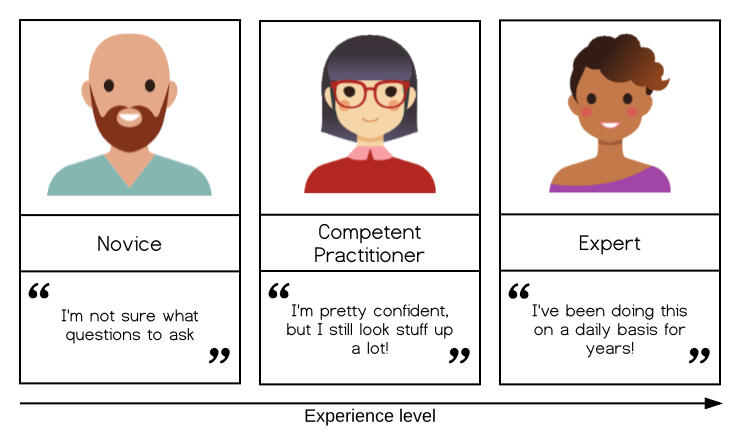
Of course, these novices may not expect to achieve the same results as an expert. They may be motivated to use genAI tools because they feel that it will help them produce better results, faster than they could do on their own.
Conceptual understanding and knowledge of relevant terminology are essential for learners to be able to articulate what they want to achieve, and to process the responses they receive. This is comparable to how the use of relevant terminology in search terms is likely to produce more relevant internet search results. But the model of skill acquisition tells us that the barrier is more than a limited vocabulary: one characteristic of a novice is that they do not know what they do not know. This means that a novice cannot articulate what they want to do, because they may not yet know what it is.
To keep improving the results they receive, and take responsibility for AI-generated outputs, learners must build their own expertise.
In a study of secondary school pupils in China, published in 2026, Stromberg, Lei, and Wu found that AI use offers immediate benefits to students in terms of homework completion time and the quality of work produced, followed by growing negative impact on exam scores (where no AI was allowed). No penalty to exam scores was observed among students who did not adopt AI in their work. Those students who adopted AI but did not take less time over their homework achieved similar exam scores to those students who did not adopt AI, but almost none of those who adopted AI saw an improvement in exam scores.
How Relevant Is This To Our Teaching?
Learners at Carpentries workshops are typically adults, as opposed to the secondary school students studied by Stromberg, Lei, and Wu. How relevant do you think their findings are to our workshops?
Some differences between workshops and secondary school education that might affect relevance:
- Learner motivation
- Exercises are completed “in class” rather than as homework
- Workshop Instructors are not responsible for grading learners
One challenge that Instructors now report encountering in workshops is that some learners will choose to copy and paste the text of an exercise into a chatbot, then copy and paste the code it produces back out again, to “solve” the exercise.
Copying/pasting Exercises
What are some ways that you might notice that students are copy/pasting the exercises in a workshop, instead of attempting them themselves? Suggest one strategy that an Instructor could employ to discourage or prevent learners from doing this.
Indications of an AI-generated solution include:
- Use of functions, syntax, language features, etc. that have not yet been introduced in the workshop.
- Complex code (more on this later).
- An abundance of comments explaining the lines of code.
- Inability for the learner to explain how the solution works.
Strategies suggested by Trainers include:
- Explain the importance of exercises for learning (transfer from working to long-term memory, metacognition)
- Celebrate the successful, manual completion of an exercise.
- Ask learners to explain their solutions.
- Follow up an exercise by asking learners to make small modifications to change the behaviour of their solutions.
(Note to Trainers: if you receive more suggestions from participants while delivering this bonus module, please open a pull request to add them to the curriculum.)
User Roles and Education
Richards et al 2026 identified five interaction modes among programmers using genAI tools:
- Navigator uses genAI to find their way around the code base.
- Autopilot asks genAI to solve their problems completely automatically.
- Deputy uses genAI incrementally to advance collaboratively toward a solution.
- Technician is similar to Deputy, but uses smaller, more granular changes that are carefully reviewed.
- Scholar uses genAI to explain concepts or provide information support.
There is an emerging consensus that Autopilot mode has the most drawbacks, both in the short term (generated solutions may be plausibly wrong) and long term (users will learn the least). Scholar and Navigator modes may have the best benefit-to-drawback ratio, as they increase the user’s knowledge rather than supplanting it. Once some expertise has been developed, Technician mode is often a step toward Deputy, and that progression should be encouraged.
Keep in mind that all of this is provisional and subject to change.
- A user needs a working mental model of a domain in order to articulate what they want to achieve and to evaluate the results they get from an AI tool.
- Instructors should encourage learners to develop their own expertise and avoid giving up their agency to genAI tools.