
Expertise and Instruction
Last updated on 2026-03-23 | Edit this page
Overview
Questions
- Does subject expertise make someone a great teacher?
- How are we (as Instructors) different from our learners and how does this impact our teaching?
Objectives
- Explain what differentiates an expert from a competent practitioner.
- Describe at least two examples of how expertise can help and hinder effective teaching.
- Identify strategies for becoming aware of your expert awareness gap.
- Demonstrate strategies for avoiding dismissive language.
Examining Your Expertise
In the last episode, we discussed the transition from novice to competent practitioner through formation of a functional mental model. We now shift our attention to experts. The expert we want to talk about is you!
Even if you do not yet think of yourself as an expert, you may nonetheless have advanced to the point where some of these key characteristics – and potential pitfalls – apply to you. We will discuss what distinguishes expertise from novices/competent practitioners, how being an expert can make it more difficult to teach novices, and some tools to help instructors identify and overcome these difficulties.
What Makes an Expert?
An earlier topic described a key difference between novices and competent practitioners. Novices lack a mental model, or have only a very incomplete model with limited utility. Competent practitioners have mental models that work well enough for most situations. How are experts different from both of these groups?
What Is An Expert?
What is something that you are an expert in? How does your experience when you are acting as an expert differ from when you are not an expert?
This discussion should take about 5 minutes.
In reviewing the answers to the question above you will find that the expert experience amounts to much more than just knowing more facts. Competent practitioners can memorise a lot of information without any noticeable improvement to their performance. So, what makes an expert? The answer is that experts have more connections among pieces of knowledge that help them think and problem-solve quickly; more “short-cuts”, if you will.
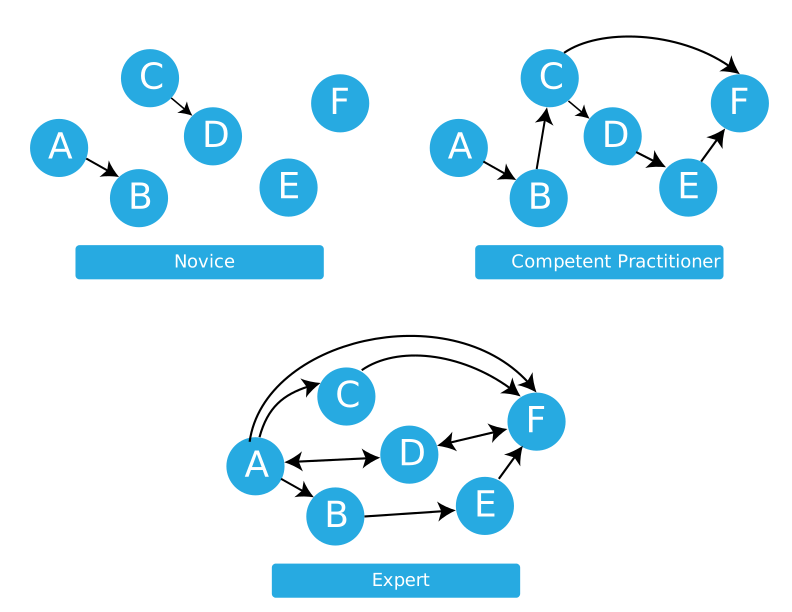
This brings us back to our mental model diagrams, where facts are nodes and relationships are arcs. The greater connectivity of a mental model allows experts to:
- see connections between two topics or ideas that no one else can see
- see a single problem in several different ways
- know how to solve a problem, or “what questions to ask”
- jump directly from a problem to its solution because there is a direct link between the two in their mind. Where a competent practitioner would have to reason “A therefore B therefore C therefore F”, the expert can go from A to F in a single step (“A therefore F”).
We will expand on some of these below and how they can manifest in the way you teach.
Expertise and Teaching
Because your learners’ mental models will likely be less densely connected than your own, a conclusion that seems obvious to you will not seem that way to your learners. It is important to explain what you are doing step-by-step, and how each step leads to the next one.
Mind The Gap
The problem with this is that when you are used to going from A to F in a single leap, it can be very hard to remember that novices need to go through steps B and C before they can understand the connection between A and F. Experts are frequently so familiar with their subject that they can no longer imagine what it is like to not understand the world that way. This phenomenon is known in the literature as an expert blind spot.
Expert Awareness Gap
In The Carpentries, we aim to create an inclusive environment. We prefer to refer to this phenomenon as the expert awareness gap to be consistent with our objective to use inclusive language. It can be exclusionary to use a term that relates to a disability for other purposes. We introduce both terms, however, to help you as future instructors engage with these ideas in the literature and with people outside of The Carpentries community.
In evaluating potential terms, one instructor provided the following thoughts:
I like expert awareness gap because it is more precise than blind spot (it is not about seeing, but about noticing) and feels more of a surmountable challenge than a disadvantage. To me a disadvantage can sometimes feel like a thing that exists as a fact, like an inevitable consequence, but a gap is a thing to be bridged– and we certainly want instructors to try to overcome (or mitigate) their expert awareness gap
Awareness gaps can lead to some interesting reversals in the classroom. While deep expertise in a subject area can be valuable when teaching, it can also create obstacles that must be overcome with practice. People with less expertise, who still remember what it is like to have to learn the things, can be better equipped to anticipate novice misconceptions compared with an expert who has not learned to identify their awareness gaps.
What does this mean for you? If you have deep expertise in the subject you are hoping to teach, listen carefully to your learners, and seek out less-expert colleagues to discuss your teaching plans. If, on the other hand, you still feel new to your subject area – perhaps you even feel a little tentative about whether you are “expert enough” to teach – take heart! Your explanations may be more likely to meet novice learners where they are.
Awareness Gaps
Choose one of the following two prompts to write about in the etherpad:
- Is there anything you are learning how to do right now? Can you identify something that you still need to think about, but your teacher can do without thinking about it?
- Think about the area of expertise you identified for yourself earlier. What could a potential awareness gap be?
This exercise should take about 5 minutes.
Switching Language
If you worked in the USA in the same building as something called a “delicatessen”, you might invite a friend to meet you at “the deli” or simply at “the restaurant” and expect them to know what you mean, because you naturally use these terms interchangeably. Yet, someone less familiar with US English might hesitate, wondering if these words mean the same thing, or close enough, under the circumstances. Similarly, in a Carpentries workshop, an Instructor may start a workshop talking about “Unix”, but then automatically start using words like “Bash” and “shell” without noticing that learners are struggling to figure out how these two new words are related.
Novice learners can be confused by interchangeable use of more than just vocabulary. In programming, multiple forms of notation may be used to reference a column in a data frame, for example, with the same effect. Instructors may use absolute file paths in one place, then default to relative file paths elsewhere without noticing that explanation is required. Or, they may assume that a learner who has an absolute file path will be able to navigate to the file in a GUI.
What do you use interchangeably?
In the Etherpad, share an example of words or notation that you sometimes use to accomplish or refer to the same thing. If possible, try to think of an example that might occur in a Carpentries workshop.
Building awareness of how you can represent the same concept in multiple different ways will help you avoid doing so without explanation while teaching.
This exercise should take about 5 minutes.
What Problem?
Experts are also better at diagnosing errors than novices or competent practitioners. If faced with an error message while teaching, an expert will often automatically diagnose and solve a problem before a novice has even finished reading the error message. Because of this, it is very important while teaching to be explicit about the process you are using to engage with errors, even if they seem trivial to you, as they often will.
Diagnosis
What is an error message that you encounter frequently in your work? (These are often syntax errors.) Take a few minutes to plan out how you would explain that error message to your learners. Write the error and your explanation in the Etherpad.
This discussion should take about 5 minutes. (Optionally, this may be discussed in group breakouts, adding 5 minutes.)
“Just” and Other Dismissive Language
Instructors want to motivate learners! We will talk more about motivation in a later episode. But here, we will take a moment to recognise one ineffective strategy often deployed by experts who want learners to believe that a task is as easy as they think it is. This often manifests in using the word “just” in explanations, as in, “Look, it is easy, you just… (wave magic wand with undecipherable incantations)” This language gives learners the very clear signal that the person helping them thinks their problem is trivial and that there must be something wrong with them if they do not experience it that way.
With practice, we can change the way we speak to avoid dismissive language and replace it with more positive and motivating word choices.
Changing Your Language
- What other words or phrases, besides “just”, can have the same effect of dismissing the experience of finding a subject difficult or unclear?
- Propose an alternate phrasing for one of the suggestions above.
Write your examples and alternatives in the Etherpad.
This exercise should take about 5 minutes.
It is hard to break the habit of trying to convince learners that a task is “easy”! A few alternatives might include statements like:
- “This task will become really easy once you have learned how to do it.”
- “We only need to learn two new commands to accomplish the next task.”
- “This task may feel like it will take you all year to learn, but in my experience it will take you a lot less time than that to master it.”
“Any Questions?”
Another well-intended move that can go wrong in the presence of awareness gaps is the call for questions. An Instructor may accidentally dismiss learner confusion by asking for questions in a way that reveals that they do not actually expect that anyone will have them. Asking, “Does anyone have any questions?” implies that most people will not; the shorter the wait time before moving on, the more this implication is magnified. Instead, consider asking “What questions do you have?” and leaving a healthy pause for consideration. This firmly establishes an expectation that people will, indeed, have questions, and should challenge themselves to formulate them.
You Are Not Your Learners
As you seek to re-acquaint yourself with the novice experience, it can be tempting to think back to your own experiences getting started in programming. Trips down memory lane can be productive! However, it is important that you take care not to generalise from your experience to that of your novice learners.
We will talk more about knowing your audience in a later episode. For now, here are two points to keep in mind when contemplating the learner experience:
- In most cases, a learner’s primary goal is not to master a subject for its own sake, but to accomplish something meaningful or solve a specific problem. They may not be interested in deep theory, background details, or extra information that does not feel immediately useful. Instead, they want practical knowledge that helps them make progress. This does not mean their curiosity will not grow over time, but their starting point may be very different from yours.
- Some learners may have avoided engaging with this subject in the past because they believe it will require too much time, effort, or frustration. These perceptions can make their motivation more fragile, especially when they encounter challenges. As a result, they may need more reassurance, relevance, and early wins to stay engaged.
This Is Not About Mastering the Entire Field
Many foundational or theoretical concepts in any field can be complex and not immediately useful. That does not mean they are unimportant.
However, when the goal is to help people get started and build confidence, practical and immediately applicable skills are often more motivating than abstract theory.
For example, someone learning how to teach does not need to begin with educational theory or pedagogy models. Instead, starting with simple techniques like structuring a lesson, asking effective questions, or engaging learners can help them improve right away. Once they gain confidence, they may be more open to exploring deeper teaching frameworks.
Expert Advantages
As we have seen, the high connectivity of an expert’s mental model poses challenges while teaching novices. However, that is not to say that experts cannot be great teachers! Because of their well-connected knowledge, self-aware experts are well-poised to help students make meaningful connections, to confidently turn an error into a learning opportunity, or to explain a complex topic in multiple ways. Experts can be highly effective as long as they learn to identify and correct for their own expert awareness gaps. Whether or not you identify as an expert, we hope this episode has started you on the path toward developing that skill.
The Importance of Practice (Again)
How can you make sure that expert awareness gaps are not negatively affecting your workshop? Keep in touch with your learners through frequent formative assessment! If you stumble into an expert awareness gap, create confusion by using interchangeable terms, or accidentally discourage rather than invite questions, formative assessment has the power to bring these problems to the surface. As you develop teaching skill, you may be able to avoid these pitfalls. Until then, becoming aware of when they occur will help you to keep their impact under control.
- Experts face challenges when teaching novices due to expert awareness gaps.
- Things that seem easy to us are often not experienced that way by our learners.
- With practice, we can develop skills to overcome our expert awareness gaps.