Image 1 of 1: ‘Three people, labeled from left to right as "Novice", "Competent Practitioner", and "Expert". Underneath,an arrow labelled "Experience level" points from left to right. The "Novice" is quoted, "I am not sure what questions to ask." The Competent Practitioner is quoted, "I am pretty confident, but I still look stuff up a lot!" The Expert is quoted "I have been doing this on a daily basis for years!"’
Figure 2
Image 1 of 1: ‘Three collections of six circles. The first collection is labelled "Novice" and has only two arrows connecting some of the circles. The second collection, labelled "Competent Practitioner" has six connecting arrows. The third collection, labelled "Expert", is densely connected, with eight connecting arrows.’
Figure 3
Image 1 of 1: ‘Two words inside rectangles, with labeled arrows connecting them. "Ball" is at the left, with an arrow pointing to "Water", at right, labeled as "Pushes out."’
Figure 4
Image 1 of 1: ‘Four words inside rectangles, with labeled arrows connecting them. "Ball" is at the left, and "Water", at right. "Big Ball" and "Small Ball" are stacked vertically between them. Arrows from "Ball" are labeled "can be MORE" and can be "LESS", and arrows to "water" are labeled as "Pushes out MORE" and "Pushes out "LESS"’
Figure 5
Image 1 of 1: ‘A concept map similar to the previous one except with "Heavy Ball" and "Light Ball" in the middle, and a red "X" over the arrows labeled "Pushes out MORE" and "Pushes out LESS"’
Figure 6
Image 1 of 1: ‘A new concept map. "Ball" remains at left, and "Water", at right. "Size" and "Weight" are stacked vertically between them. Arrows from "Ball" share the label "Can have more or less." One arrow from "size to "water" is labeled "Affects pushing of"’
Image 1 of 1: ‘Three collections of six circles. The first collection is labelled "Novice" and has only two arrows connecting some of the circles. The second collection, labelled "Competent Practitioner" has six connecting arrows. The third collection, labelled "Expert", is densely connected, with eight connecting arrows.’
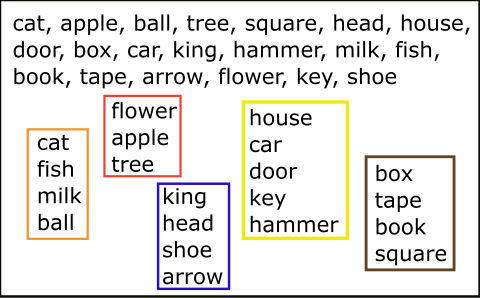
Image 1 of 1: ‘A list of words: cat, apple, ball, tree, square, head, house, door, box, car, king, hammer, milk, fish, book, tape, arrow, flower, key, shoe. Underneath, the same words are organised into boxes with related terms e.g. cat fish milk ball and apple flower tree"’
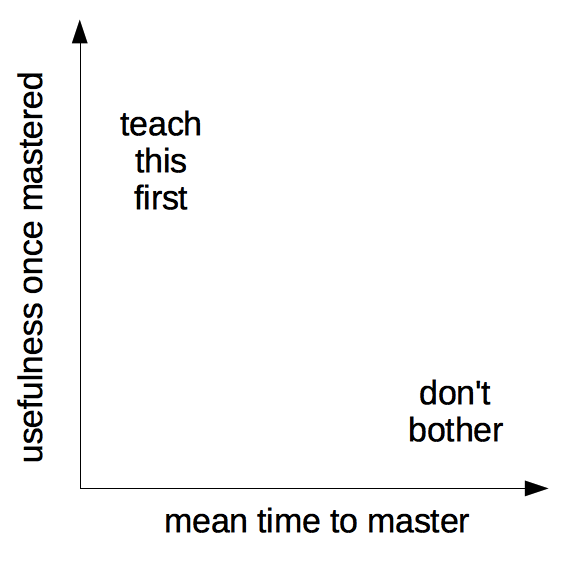
Image 1 of 1: ‘A stylised graph with y-axis labeled "usefulness once mastered" and and x-axis labeled "mean time to master". The upper left quadrant says "teach this first" and the lower right quadrant says "do not bother".’
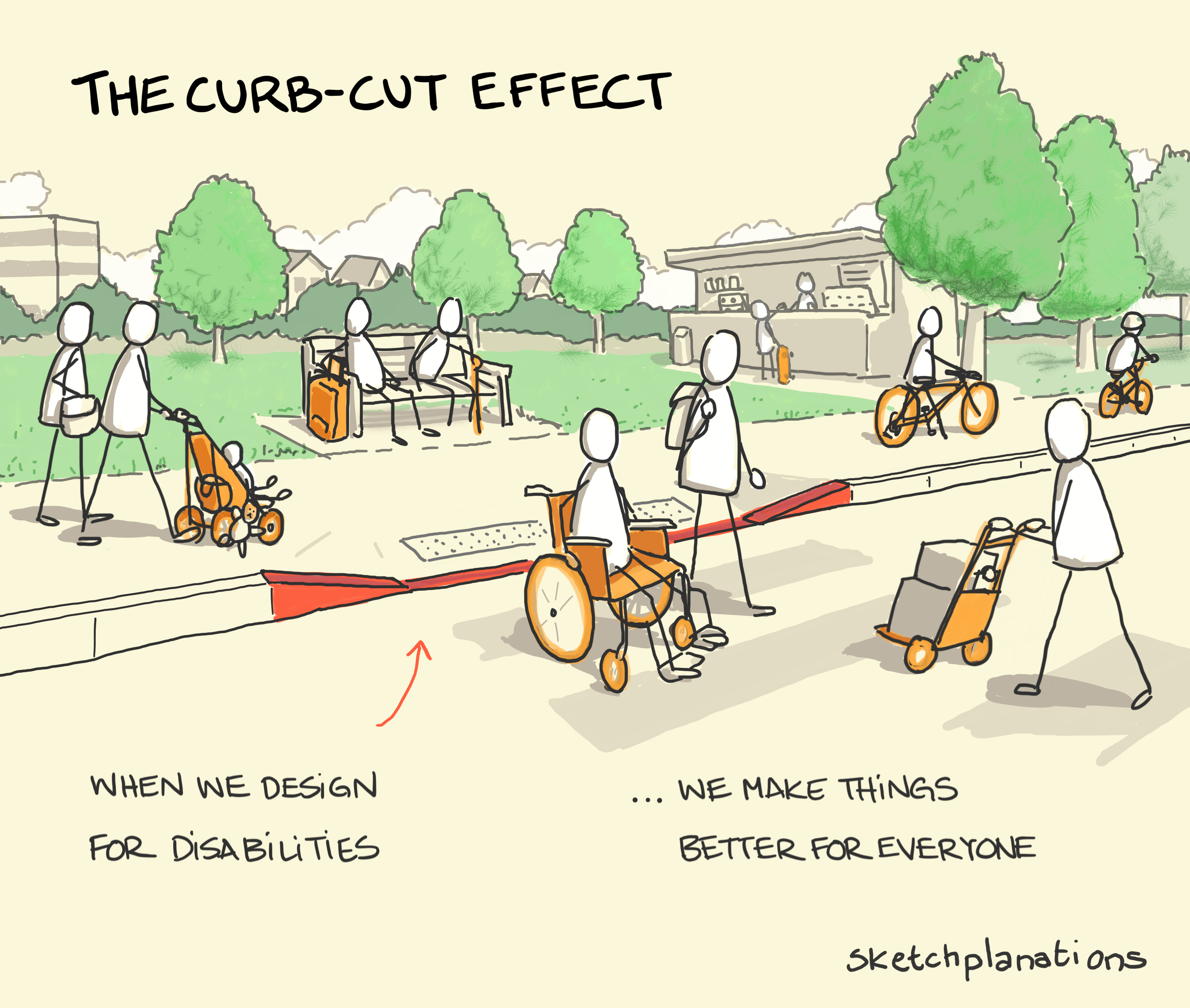
Image 1 of 1: ‘People using different wheeled devices utilising the curb cut. The picture is titled The Curb-Cut Effect and states "when we design for disabilities, we make things better for everyone."’
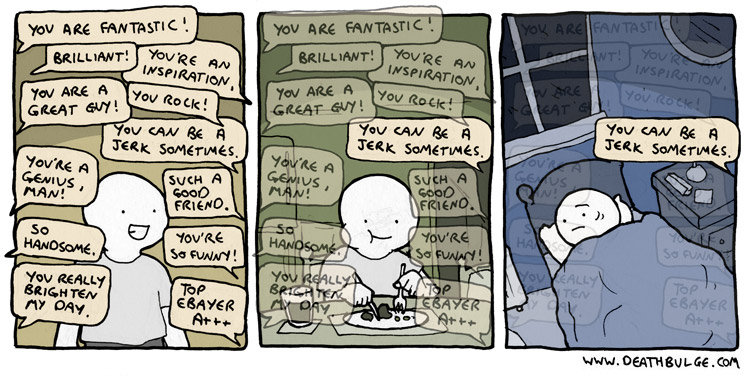
Image 1 of 1: ‘A three panel comic. In the first panel, a smiling figure is surrounded by speech bubbles with mostly positive feedback. In the second panel, the figure is eating dinner. All of the previous speech bubbles appear faded out, except the one negative bubble. The third panel shows the figure in bed, with an unhappy face, with the one piece of negative feedback lingering after all others have faded.’
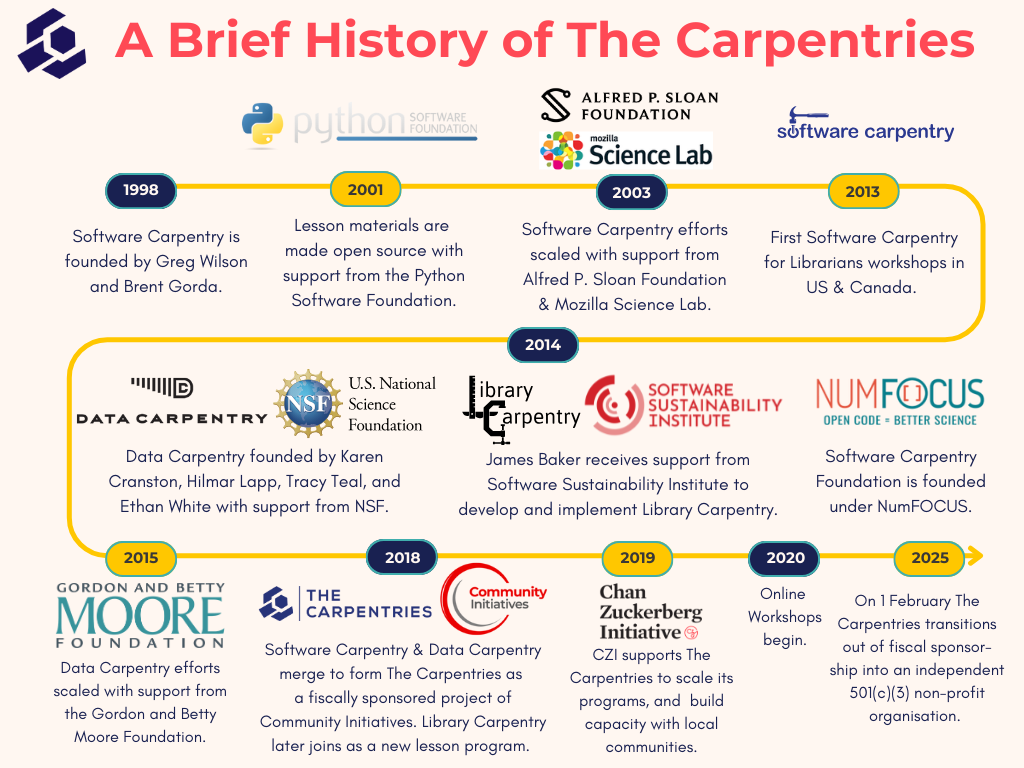
Image 1 of 1: ‘A graphic depicting the development of The Carpentries. It is titled “A Brief History of The Carpentries” with The Carpentries logo to the left of the title. The graphic is a snaking timeline chart summarising significant transitions in The Carpentries' history from 1998 to 2025. Not all years are represented. Under each year is a brief summary of the key developments in that year, with logos of the funder organisations that supported that phase of the organisation's projects. The dates and accompanying text are as follows: 1998: Software Carpentry is founded by Greg Wilson and Brent Gorda. 2001: Lesson materials are made open source with support from the Python Software Foundation. 2003: Software Carpentry efforts scaled with support from Alfred P. Sloan Foundation & Mozilla Science Lab. 2013: First Software Carpentry for Librarians workshops in US & Canada. 2014: Data Carpentry founded by Karen Cranston, Hilmar Lapp, Tracy Teal, and Ethan White with support from NSF. 2014: James Baker receives support from Software Sustainability Institute to develop and implement Library Carpentry. 2014: Software Carpentry Foundation is founded under NumFOCUS. 2015: Data Carpentry efforts scaled with support from the Gordon and Betty Moore Foundation. 2018: Software Carpentry & Data Carpentry merge to form The Carpentries as a fiscally sponsored project of Community Initiatives. Library Carpentry later joins as a new lesson program. 2019: CZI supports The Carpentries to scale its programs, and build capacity with local communities. 2020: Online Workshops begin. 2025: On 1 February The Carpentries transitions out of fiscal sponsor-ship into an independent 501(c)(3) non-profit organisation. 2026: High Performance Computing (HPC) Carpentry, founded in 2018, joins as the fourth lesson program.’